

Telecom FTTx
MAXON Telecom FTTx – Active Optical Network (AON) Solution
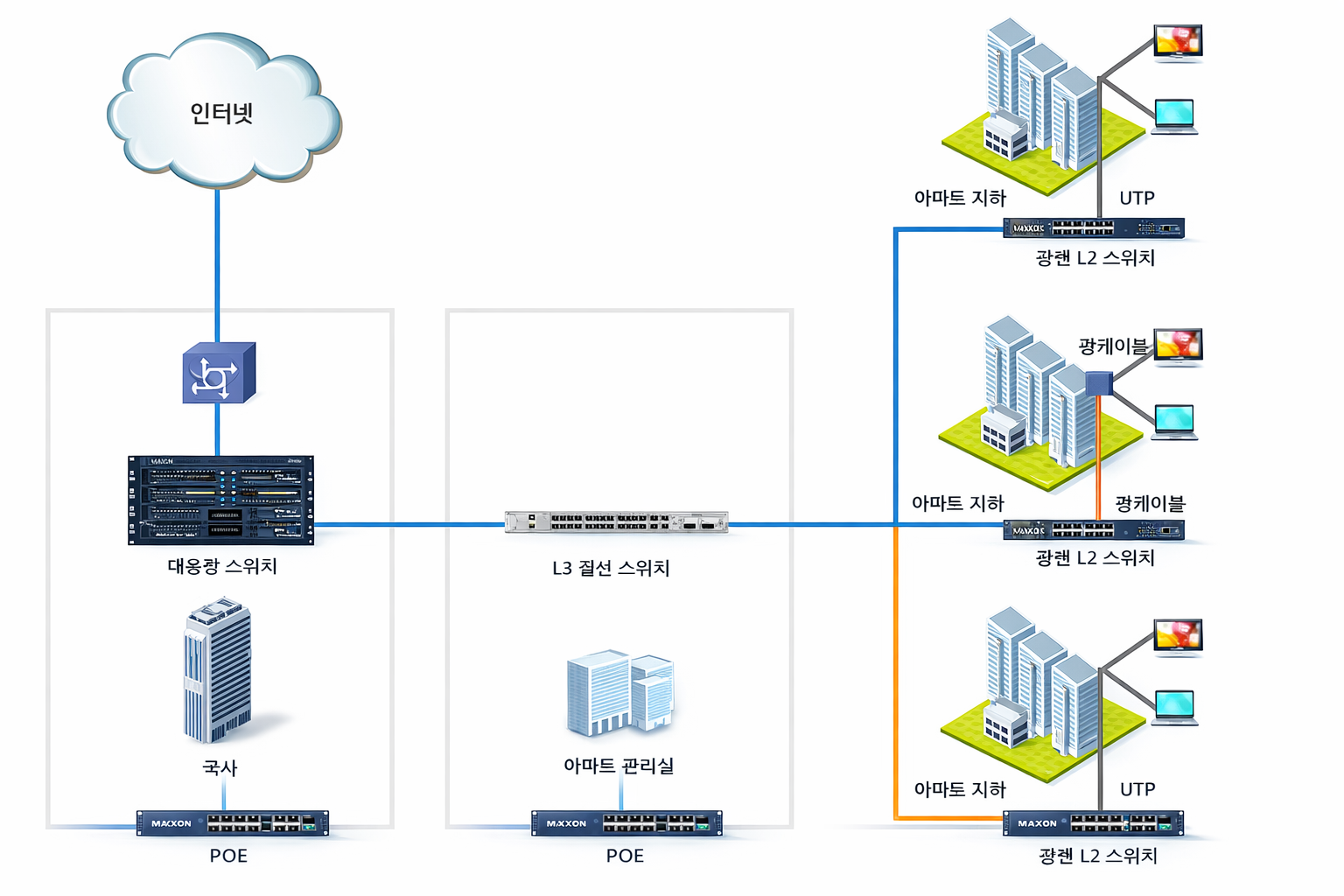
The Active Optical Network (AON) architecture deploys Remote Nodes (RN) equipped with Ethernet switching capabilities at strategic locations within subscriber areas, such as cabinets, shelters, controlled environment vaults (CEV), or utility poles. From these nodes, subscribers are connected via optical fiber links.
In this architecture, the connection between the central office and the Remote Node is established through a single optical fiber link, significantly reducing the amount of fiber required in both feeder and distribution network segments.
The AON solution utilizes standardized Ethernet communication technologies defined by IEEE 802.3, supporting optical transmission such as 100Base-FX and 100/1000Base-LX, enabling stable connectivity over distances exceeding 5 km. Data is transmitted using Ethernet packet switching, where each switching node performs point-to-point MAC-level communication.
By leveraging standard Ethernet technologies, AON eliminates the need for proprietary FTTH-specific MAC protocols, offering a simpler and more direct service architecture. Additionally, as an active network, signal regeneration occurs at Remote Nodes, ensuring reliable transmission even over long distances between the central office and end users.
The AON approach is particularly suitable for high-density residential environments such as apartment complexes. A central communication room (MDF) within the building can host Gigabit optical switches and servers supporting Triple Play Services (TPS), while Fast Ethernet switches with optical uplinks are deployed in each building or floor equipment room. This enables seamless integration of security systems, automation devices, and other Ethernet-based terminals.
Furthermore, AON ensures full compatibility with various multimedia services, including VoIP, video calling, and Video on Demand (VOD), across residential units and facility systems such as security offices. Its cost-effective infrastructure and use of standard Ethernet equipment make it an efficient solution for large-scale deployments.
In environments where fiber infrastructure is already available (e.g., premium residential developments), fiber can be extended directly to each subscriber unit, and media converters can be used within the home to connect to user devices via UTP cabling.